Showing posts with label Research. Show all posts

Monday, 31 December 2012

Research Moratoriums And Recipes For Superbugs: Bird Flu In 2012

Researchers at the U.S. Geological Survey National Wildlife Health Center in Madison, Wis., use eggs to see if the Asian strain of the H5N1 bird flu virus has entered the U.S. in this photo from 2006.

Andy Manis/AP Researchers at the U.S. Geological Survey National Wildlife Health Center in Madison, Wis., use eggs to see if the Asian strain of the H5N1 bird flu virus has entered the U.S. in this photo from 2006. Researchers at the U.S. Geological Survey National Wildlife Health Center in Madison, Wis., use eggs to see if the Asian strain of the H5N1 bird flu virus has entered the U.S. in this photo from 2006.

Andy Manis/AP

For scientists who study a dangerous form of bird flu, 2012 is ending as it began — with uncertainty about what the future holds for their research, but a hope that some contentious issues will soon be resolved.

Last January, dozens of flu experts around the world agreed to what was supposed to be a 60-day pause in controversial experiments on the H5N1 bird flu virus. But none of them resumed work as planned because all year long, the debate over the benefits and the risks just wasn't going away.

Virologist Ron Fouchier of Erasmus Medical Center in the Netherlands says he reluctantly went along with the moratorium, "but I've not been a great advocate of it because there is urgency in this type of research."

Fouchier gets funding from the National Institutes of Health to study H5N1, which is widespread in poultry in parts of Asia and the Middle East.

H5N1 rarely infects humans, but more than half of those known to have gotten sick with it have died. Scientists have long wanted to know if this bird flu could mutate in a way that could make the virus start spreading between people and cause a pandemic.

Friday, 28 December 2012

Despite Uneven Results, Alzheimer's Research Suggests A Path For Treatment

Brain scans using Amyvid dye to highlight beta-amyloid plaques in the brain. Clockwise from top left: a cognitively normal subject; an amyloid-positive patient with Alzheimer's disease; a patient with mild cognitive impairment who progressed to dementia during a study; and a patient with mild cognitive impairment.

Brain scans using Amyvid dye to highlight beta-amyloid plaques in the brain. Clockwise from top left: a cognitively normal subject; an amyloid-positive patient with Alzheimer's disease; a patient with mild cognitive impairment who progressed to dementia during a study; and a patient with mild cognitive impairment.

Slide courtesy of the journal Neurology

It's been a mixed year for Alzheimer's research. Some promising drugs failed to stop or even slow the disease. But researchers also found reasons to think that treatments can work if they just start sooner.

Scientists who study Alzheimer's say they aren't discouraged by the drug failures. "I actually think it was a phenomenal year for research," says Bill Rebeck, a brain scientist at Georgetown University.

Rebeck is optimistic because during the year, several very different lines of research all began to suggest a new way of thinking about Alzheimer's — that it has to be stopped before it damages the brain.

"Once you start to lose a lot of synapses, once you start to lose a lot of neurons, your brain can't recover from that," Rebeck says. "And so when we start with people who have symptoms of the disease, treating them turns out to be unsuccessful."

That explanation comes in part from studies that used a new research tool approved by the Food and Drug Administration in April. The tool is a drug called Amyvid that's injected into the bloodstream and travels to amyloid plaques in the brain. Those are the plaques associated with Alzheimer's.

The dye, also called florbetapir, lets researchers detect even tiny plaques using a positron emission tomography, or PET, scanner.

"In the PET scan you can see whether somebody has amyloid in their brain...before [they show] symptoms of the disease. I think that's huge," Rebeck says.

Researchers have already used the technique to show that amyloid begins to build up decades before people start having problems with memory or thinking. Rebeck says it should also provide a much quicker way to gauge whether a new Alzheimer's treatment is working.

Another advance this year was a study showing that the brain begins to function differently long before symptoms of Alzheimer's appear.

Lori Beason-Held of the National Institute on Aging presented the study at the Society for Neuroscience meeting. She says previous research had found brain changes among people in the early stages of Alzheimer's.

"Our study has gone back even further and discovered changes in the brain that occur up to 11 years before any symptoms occur in individuals who eventually become cognitively impaired," says Beason-Held. And the changes probably start even earlier, she says.

That might sound discouraging, but Rebeck doesn't see it that way. "What that says is there's an opportunity, there's a window when if we could stop that amyloid from accumulating, or start to clear it out of the brain, then you could prevent those symptoms from actually ever happening," he says.

Another study this year suggests a way to do that. Researchers in Iceland discovered that families with a rare gene mutation are much less likely to get Alzheimer's. The mutation appears to interrupt a key step in the formation of amyloid.

In order to form amyloid, the brain has to first cut up a larger molecule, explains Robert Vassar of Northwestern University. That step requires an enzyme called beta-secretase or BACE 1.

"BACE 1 is like a pair of molecular scissors, and what the mutation does is sort of interfere with the way the molecular scissors can cut. It sort of like, dulls the blades," Vassar says.

Just a few months ago researchers came up with a drug that does the same thing that the gene mutation does naturally, says Rebeck. This drug, though, may have to be administered before amyloid has begun to build up.

Michael Raffi, of the University of California, San Diego, says the new thinking about amyloid and Alzheimer's is a bit like the current approach to cholesterol and heart disease. Doctors don't wait until someone has a heart attack before putting them on drug that lowers cholesterol.

"Really the ideal situation is to have checked their cholesterol levels 15 years prior, and seen whether it was elevated, which would imply that they have an elevated risk of having the heart attack, and starting the medication then," Raffi says.

It's still not clear, though, whether amyloid is the new cholesterol. "It took a long time for us to make that connection between cholesterol and heart disease," says Rebeck. "That's been very successful. It's been very helpful in so many people's lives. We're just [at] earlier stages in studying Alzheimer's disease."


View the original article here

Tuesday, 18 December 2012

Research Chimps Get Permanent Retirement Home

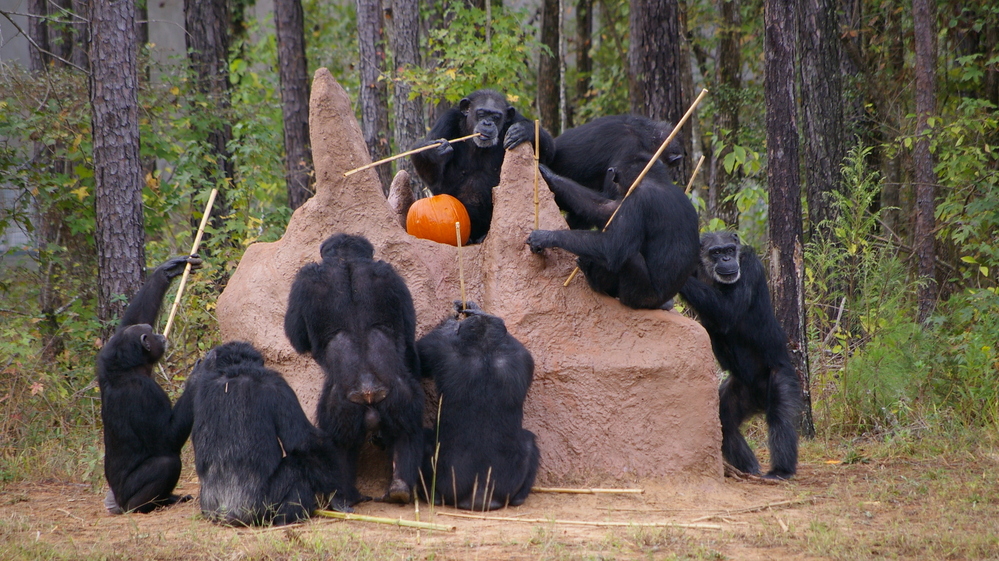
Chimpanzees check out a termite mound at the Chimp Haven sanctuary in Louisiana.

Chimp Haven Chimpanzees check out a termite mound at the Chimp Haven sanctuary in Louisiana. Chimpanzees check out a termite mound at the Chimp Haven sanctuary in Louisiana.

Chimp Haven

More than 100 chimps retired from medical research are about to get a new home.

Most of the primates who have been living at the New Iberia Research Center will soon make their permanent residence at the Chimp Haven sanctuary, the National Institutes of Health said Wednesday.

The federally owned primates have been the subject of controversy. In 2010, the NIH made arrangements to move some retired chimps back into the research, spurring protests from several animal rights groups.

An independent report released last December said there was almost no scientific need for doing biomedical research on chimps. In September, the NIH accepted the report's recommendations and formally retired all chimps at the NIRC, despite some scientists' objections.

Initially, only 10 retired NIRC chimpanzees were expected to arrive at Chimp Haven. Though 10 new residents would have filled the Louisiana sanctuary to capacity, behaviorists were able to create some extra space by carefully rearranging the chimpanzees into new social groups.

"It's actually a very complex process. They have to evaluate their health status, their behavioral attributes, and then they determine how [the chimps] will act in various social groups," says Renate Myles, an NIH spokeswoman. "[The behaviorists] will say, 'Oh I think these chimpanzees will do nicely with these other chimpanzees,' then they try it. If it doesn't work, they have to start all over again," she tells Shots.

In addition to the space created by social reorganization, Chimp Haven will look to expand its facilities with new enclosures that are expected to cost about $2.3 million.

Congress authorized $30 million for the care of chimps retired from biomedical research in the Chimpanzee Health Improvement, Maintenance, and Protection Act in 2000. But the NIH is nearing this cumulative cap, and it can't pay for an expansion at the sanctuary.

The Humane Society of the United States and the Foundation for the National Institutes of Health (an independently funded nonprofit) have pledged to cover the cost of the new facilities.

"NIH has worked diligently to see that the federally owned chimps at New Iberia Research Center will be sent to a world-class sanctuary and the Humane Society of the United States is pleased to fund a portion of the construction costs," said Wayne Pacelle, president and CEO of the Humane Society, in a statement earlier today.

Though only 110 chimpanzees were retired from NIRC in September, 113 will be arriving at Chimp Haven in the next year or so. Eight of the original chimps gave birth to babies. One animal died, and four more were declared too old and frail to make the trip to the sanctuary, NIH's Kathy Hudson said in a media briefing.


View the original article here

NIH Revisits Debate On Controversial Bird Flu Research

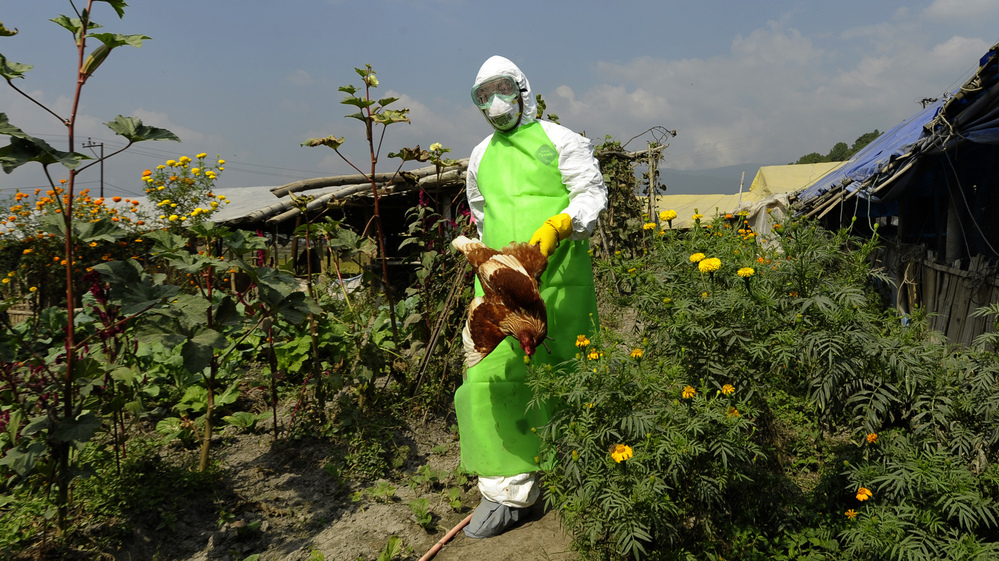
A prefectural officer carries a chicken on a poultry farm on Oct. 15 on the outskirts of Kathmandu, Nepal, where chickens suspected of being infected with bird flu were found.

Prakash Mathema /AFP/Getty Images A prefectural officer carries a chicken on a poultry farm on Oct. 15 on the outskirts of Kathmandu, Nepal, where chickens suspected of being infected with bird flu were found. A prefectural officer carries a chicken on a poultry farm on Oct. 15 on the outskirts of Kathmandu, Nepal, where chickens suspected of being infected with bird flu were found.

Prakash Mathema /AFP/Getty Images

On Tuesday, the National Institutes of Health in Maryland is holding a second day of talks about whether and how to continue funding some controversial scientific experiments.

Back in January, virologists agreed to temporarily stop research that was creating new forms of bird flu because critics argued that the work was too dangerous. NIH officials are now seeking input from scientists and the public about how to proceed.

Scientists, national security experts and public health workers have come from all over — including places like the United Kingdom, Hong Kong, Italy, Indonesia and Vietnam — to discuss thorny issues raised by the research.

"The subject of this meeting literally affects every individual in the world," noted Harvey Fineberg, president of the Institute of Medicine of the National Academies, who is helping to run the conference. "Every citizen in every country has a stake in the research that will or will not go forward with respect to these highly pathogenic agents."

These pathogenic agents are altered forms of the bird flu virus known as H5N1. H5N1 is widespread in poultry in parts of Asia and the Middle East, but it rarely infects people. Over half of the people known to have gotten sick, however, have died.

Public health experts worry that the virus might mutate, begin spreading from person to person and start a pandemic. Last year, NIH-funded researchers showed that certain genetic mutations could indeed make H5N1 spread easily between ferrets, the lab stand-in for people.

When word got out that scientists had created these mutant viruses, there was an uproar.

"There was an explosion of reaction, sometimes bordering on the very extreme," recalled Anthony Fauci, the director of the National Institute of Allergy and Infectious Diseases. One New York Times editorial called it "An Engineered Doomsday."

So flu virologists around the world agreed to temporarily hold off on this kind of research. But some, like Ron Fouchier of Erasmus Medical Center in the Netherlands, thinks it's essential to get back to work.

Fouchier says what is learned from this research could help public health experts do things like spot an emerging pandemic or develop vaccines. In his view, it's irresponsible to not follow up on his initial experiments.

"All of this research is aimed to prevent flu pandemics or to mitigate their impact if they cannot be prevented altogether," Fouchier says.

Others are not so convinced and say that if an engineered bird flu virus fell into the wrong hands or escaped the lab, it could kill millions.

"Once novel flu gets going in the population, it's unlikely we could stop it," says Thomas Inglesby with the Center for Biosecurity at the University of Pittsburgh Medical Center.

Inglesby thinks the moratorium should continue, but that if the NIH decides it will fund more research on altered forms of H5N1, everyone should acknowledge the risks.

"I think we should also proceed in unprecedented biosafety conditions and with international agreements on how to proceed," he says.

Officials have drafted a set of proposed criteria to help them decide whether and when to fund this kind of research in the future. For example, a proposed experiment would have to address a scientific question with high significance to public health, and there would have to be no feasible alternative methods to address the same question in a less-risky way.

One of the reasons NIH is holding this conference is to see what people think of that proposed framework.

This question of the moratorium can't be decided at this meeting because not all of the researchers who signed onto it are funded by NIH. But what the NIH says and does is influential, so what comes of this meeting and how it is incorporated into NIH decision-making could be important.

On the agenda for Tuesday is a discussion of what kinds of lab safety measures should be in place to do this kind of work. Some experts say it should be restricted to the most secure labs possible. Others say that would needlessly slow down research that's vital for understanding the threat of naturally occurring flu pandemics.

A video of the meeting will be posted online for those who could not attend, and NIH officials say they'll be accepting emailed comments on their proposed framework for decision-making until Jan. 10.


View the original article here